QA for SaaS essentials: multi-tenancy isolation, subscription webhook chaos, and load testing. Prevent week-one disasters with pre-launch validation.
Why does multi-tenancy make QA harder for SaaS products?
Multi-tenant SaaS must validate not just that features work — but that one user's data, session, and resources cannot affect another user's. Single-tenant applications never face this. One trust boundary failure can destroy a product overnight.
A banking app update exposed one customer's account details (balance, transaction history) to a different user. Root cause: an unsecured API that assumed mobile authentication was sufficient. It never validated that the user ID matched the authenticated account. This wasn't a sophisticated attack. It was a basic QA failure — one that never surfaced in single-user test scenarios but appeared immediately under real concurrent load.
QA for SaaS products requires testing scenarios that simply don't exist in single-tenant applications: tenant isolation, resource allocation fairness, and data privacy under concurrent users. Multi-tenancy, continuous deployment, subscription complexity, and uptime expectations create failure modes that generic QA processes miss entirely.
What makes SaaS testing different from traditional application testing?
Four characteristics of SaaS products create failure modes that traditional QA doesn't cover:
- Multi-tenancy compounds risk exponentially. One company experienced a complete outage when a single tenant ran load tests on shared infrastructure — taking down hundreds of other customers simultaneously. No monitoring detected the abuse. No resource limits prevented the cascade.
- Continuous deployment eliminates traditional QA gates. Organizations shipping daily or weekly can't rely on multi-week regression cycles. The testing strategy must answer one question: did we break what already worked? Test automation becomes essential infrastructure, not optional optimization.
- Uptime expectations create 24/7 accountability. SaaS customers expect 99.9% availability — that's 8.76 hours of total downtime per year. A production defect requiring rollback consumes hours of this budget.
- Security and compliance (GDPR, SOC2) are launch blockers if core controls are missing — not post-launch cleanup items.
What QA must you complete before launching a SaaS product?
The single non-negotiable: production-like end-to-end validation of the core customer journey. Paying customers care about four outcomes — they can sign up, use the core feature, trust their data is safe, and get a clear result. If any fail in the first week, you lose customers you'll never recover.
Why teams skip this: it's slow, it crosses team boundaries (frontend, backend, database, integrations), and it exposes uncomfortable gaps between how the product was designed and how it actually behaves. These are all terrible reasons. The cost of skipping is week-one churn, support volume you can't handle, and reputation damage that undermines marketing.
- Functional testing across user personas — validates that admins, standard users, guests, and trial users each experience correct behavior on critical paths. A common failure: admin-only features accidentally accessible to standard users, or trial users bypassing payment gates.
- Integration testing for third-party dependencies — validates SSO providers, payment gateways, email services, and API integrations under failure conditions. When Stripe webhooks fail, when Auth0 times out, when SendGrid rejects emails — what does your product actually do? Test failure modes, not just happy paths.
- Performance testing under concurrent load — reveals whether your architecture handles real usage. Concurrent users stress database connections, API rate limits, cache layers, and background job queues. Load exposes race conditions, deadlocks, and resource exhaustion.
- Data migration validation — matters if you're moving existing users from another platform. Users whose historical data is lost or corrupted during migration rarely return. This is a one-way door — get it right before launch.
How do you validate multi-tenant data isolation before launch?
Attempt to break it deliberately. Passive functional testing will not find tenant isolation bugs — only adversarial testing will.
Test cross-tenant access via: modified API parameters (substitute another tenant's ID), forged or replayed JWTs, SQL injection targeting tenant filters, session replay from a different tenant's authenticated session. If any of these succeed, you have a critical pre-launch blocker. QA services for SaaS products treat tenant isolation as the highest priority test category — above feature coverage, above performance.
What security testing is required before a SaaS launch?
Minimum viable security testing pre-launch covers four areas, in order of priority:
- Authentication — password reset flows, session management, MFA if offered
- Authorization — cross-tenant access attempts, trial-to-paid bypass attempts
- OWASP Top 10 validation — the most common web application vulnerabilities
- Dependency scanning — known vulnerabilities in third-party libraries
One additional item that teams consistently skip: a human-driven abuse test. Deliberately attempt to break access controls manually — not with a scanner. Automated tools miss logic-level authorization flaws that a motivated tester finds in minutes. This is not a full penetration test. It is one focused session targeting your most sensitive data flows.
What to avoid spending time on before launch: full penetration tests (expensive, better post-launch), full compliance programs like SOC2 or ISO 27001 (take 6–12 months), and custom cryptography (use proven libraries). Security debt is real — but launch-blocking security is a short list.
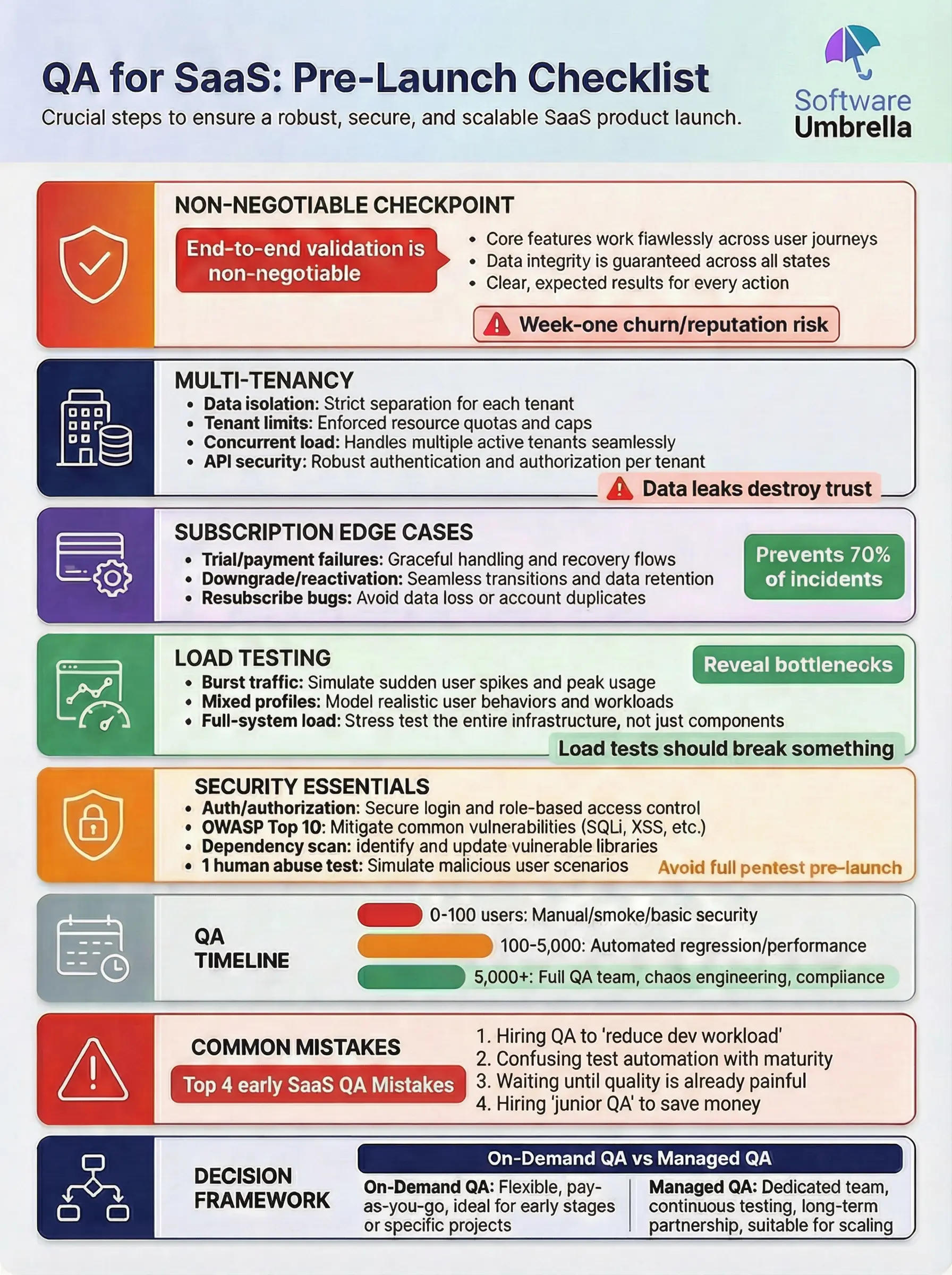
QA for SaaS Pre-Launch Checklist
What subscription edge cases does QA need to test in SaaS?
Subscription flows look simple in design docs. In production they are chaos — trials, upgrades, downgrades, payment failures, retries, cancellations, and webhooks arriving out of order. The scenarios that QA teams consistently miss are the ones where multiple events collide.
Three real-world collision scenarios:
- Double charge: Trial starts → payment fails → user upgrades to annual plan → retry succeeds on old monthly invoice. User gets charged twice. Support spends hours untangling billing history.
- Ghost reactivation: Active subscription → downgrade scheduled for period end → payment fails → user cancels → webhook reactivates subscription. User intended to cancel; system resurrects their account.
- Access loss after valid payment: User cancels at period end → immediately resubscribes → old cancellation webhook fires days later. User loses access despite active payment.
Why testing catches these late: test scenarios assume clean billing timelines. Webhooks are tested in isolation, not concurrently with user actions. Manual testers don't simulate time passage, retries, and user actions happening simultaneously.
How do you prevent webhook chaos from breaking subscription management?
One rule prevents 70% of subscription incidents: webhooks may update billing facts, but they must never override newer user intent. If a user cancels at 2:00 PM and a webhook arrives at 2:05 PM declaring the subscription active — the cancellation wins.
To test this effectively: define your source of truth first (does webhook state override user intent, or vice versa?). Then build one comprehensive nightmare scenario test combining payment failure, retry, user action, and deliberately out-of-order webhooks. Force webhook disorder. Test access and entitlements, not just subscription status fields.
User onboarding testing validates that new users can complete activation, understand core value, and convert before trial expiration. If activation takes more than 5 minutes or requires reading documentation, you have an onboarding problem — not a documentation problem.
GDPR compliance testing ensures users can export their complete data and that account deletion actually removes personal data across all systems: databases, logs, backups, and analytics platforms. Test this explicitly before launch — not as a post-launch cleanup.
How do you build a CI/CD QA strategy for daily SaaS deployments?
Need Expert Help with Your Project?
Our team of specialists can help you implement these strategies effectively. We deliver practical solutions for QA, development, and team augmentation. Let's discuss how we can help you ship quality software faster.
Automation scales confidence. Manual testing scales understanding. You need both — but for different things. Enough automation means covering revenue, data, and core workflows on every deploy. Nothing more, nothing less at the start.
CI/CD pipeline integration runs automated tests on every commit or pull request. Target under 15 minutes for regression suite completion. Developers must get feedback fast enough to act on it before context switches.
Automated regression for daily deploys covers authentication, core feature workflows, payment processing, and data integrity checks. These tests must be reliable — flaky tests destroy automation trust. When 20% of failures are false positives, teams start ignoring all failures.
Smoke tests post-deployment run immediately after each release: app starts, key pages load, APIs respond, database connects. If smoke tests fail, rollback immediately. These should complete in 2–3 minutes maximum.
Managed QA services for SaaS products combine automated testing with production monitoring to create continuous quality feedback loops — error rate spikes, response time degradation, and background job failures all signal testing gaps before users report them.
When should SaaS teams use manual testing instead of automation?
Manual testing when: requirements are new, fuzzy, or evolving; product decisions were made late in the sprint; UX or edge behavior matters more than pure logic; you need to find what you don't know to look for.
Automate the boring certainty — regression paths that are stable, predictable, and repeat on every deploy. Manually explore the dangerous uncertainty — new features, changed flows, security edge cases, and anything involving real human judgment about usability or correctness.
How should QA strategy change as a SaaS product scales?
QA approaches that work at 100 users break at 10,000. The failure modes shift as scale increases — performance first, then data integrity, then monitoring gaps, then third-party integration limits, then QA process capacity.
Early stage (MVP to first 100 users): Product-market fit is uncertain, features change rapidly. Focus on manual exploratory testing of core workflows, basic smoke tests, security fundamentals, and production-like end-to-end validation before launch. Avoid over-investing in automation for features that may not survive product iteration.
Growth stage (100 to 5,000 users): Product-market fit is validated, feature set stabilizes. Invest in automated regression covering all critical paths, performance testing under realistic concurrent load, security testing expansion, and dedicated QA capacity — on-demand QA or first QA hire.
Enterprise stage (5,000+ users): Product complexity increases, compliance becomes mandatory. Requires dedicated QA team (automation engineers, manual testers, performance specialists), chaos engineering practice, advanced security testing, and compliance testing (SOC2, ISO, GDPR).
What breaks first when a SaaS product scales from 100 to 10,000 users?
In order of what fails first: database connection pools exhaust under concurrent load; API rate limits get hit (both your own and third-party); race conditions and orphaned records surface at scale; monitoring gaps mean you learn about failures from user reports not alerts; Stripe and Auth0 connection limits become real constraints; and manual QA simply cannot keep pace with release velocity.
What to do differently starting at 100 users: simulate 10x concurrent users with load testing tools even before you have that scale. Build observability infrastructure from day one. Establish performance regression monitoring. Use feature flags to decouple deployment from release. Automate revenue-critical paths before they become bottlenecks.
What are the most common SaaS QA mistakes before launch?
Launching without load testing is the most common. Teams test functionality with one user at a time. Production has hundreds of concurrent users. Load exposes resource contention, database deadlocks, cache invalidation bugs, and API rate limit violations that never appear in functional tests.
False confidence from steady-state load testing. Test burst traffic patterns and mixed user profiles — not just average load. Test with deliberate cache failures. A good load test should break something and reveal a bottleneck. If it just passes cleanly, you tested the wrong scenario.
Ignoring subscription edge cases. Real users change plans constantly, experience payment failures, cancel and resubscribe unpredictably. Happy-path subscription tests pass; chaos scenarios expose production support nightmares.
Poor data migration validation. Users whose historical data is lost or corrupted during migration churn at extremely high rates. Test migration with production-like data volumes, not toy datasets.
Insufficient security testing. Minimum viable security pre-launch is a short list (authentication, authorization, OWASP Top 10, dependency scanning, one human abuse test) — but teams skip it entirely assuming it can be fixed post-launch. It cannot.
How do you build a QA process that scales with your SaaS product?
Start with the non-negotiable: production-like end-to-end validation of the core customer journey. This single test — signup, core feature, data safety, clear result — prevents the majority of week-one disasters.
Then prioritize multi-tenancy isolation testing if your product is multi-tenant. Data leakage and resource cannibalization are not bugs you fix post-launch — they are trust-destroying events.
Build automation incrementally starting with revenue-critical paths: authentication, core workflows, payment processing, data integrity. Expand coverage as features stabilize — not before.
Invest in observability from day one. Logging, metrics, tracing, and error tracking bridge the gap between what tests cover and what production reality reveals. Testing and monitoring are complementary disciplines, not sequential phases.
Which QA model fits early-stage vs growth-stage SaaS companies?
Early-stage SaaS (MVP, first 100 users, fast iteration): on-demand QA provides flexibility without full-time commitment. Engage for pre-launch validation, specific security testing, or release surge capacity — pay only for what you need while the product finds its shape.
Growth-stage SaaS (validated product-market fit, stable feature set, scaling users): managed QA services provide the dedicated capacity and automation infrastructure that on-demand resources can't sustain. You need a team that accumulates product knowledge, owns the test automation framework, and integrates into your sprint cadence.
Frequently Asked Questions
What is the most important QA test before launching a SaaS product?
Production-like end-to-end validation of the core customer journey: signup, core feature usage, data safety, and a clear result. If this fails in week one, you lose customers you will not recover. Everything else is secondary to this single validation.
How do you test multi-tenant data isolation in SaaS?
Test it adversarially — attempt cross-tenant access via modified API parameters, forged JWTs, SQL injection targeting tenant filters, and session replay from a different tenant's session. Passive functional testing will not find tenant isolation bugs. Only deliberate adversarial testing will surface them before your users do.
What are SaaS subscription edge cases that QA teams commonly miss?
The most dangerous are collision scenarios where multiple events happen simultaneously: plan upgrades during active payment retries, cancellations followed immediately by resubscription with stale webhooks firing, and downgrade webhooks arriving after a user has already upgraded. These scenarios don't appear in happy-path testing — they require deliberate simulation of out-of-order events.
How do you prevent subscription webhook bugs in production?
One rule prevents 70% of subscription incidents: webhooks may update billing facts, but they must never override newer user intent. If a user cancels at 2:00 PM and a webhook arrives at 2:05 PM declaring the subscription active, the cancellation wins. Define this rule explicitly in your system and test it with deliberately out-of-order webhook sequences.
What load testing should a SaaS product do before launch?
Test burst traffic patterns, not just average load. Simulate 10x your expected concurrent users. Test with deliberate cache failures. Use mixed user profiles rather than identical synthetic users. A good load test should break something and reveal a bottleneck — if it passes cleanly, you likely tested the wrong scenario or used unrealistic data.
What security testing is required before a SaaS launch?
Minimum viable security testing covers: authentication flows (password reset, session management, MFA), authorization testing (cross-tenant access attempts, trial-to-paid bypass), OWASP Top 10 validation, dependency scanning for known vulnerabilities, and one human-driven abuse test targeting your most sensitive data flows. Full penetration tests and compliance programs (SOC2, ISO) are post-launch investments.
When should a SaaS startup use on-demand QA vs a managed QA team?
Early-stage startups (MVP to first 100 users, rapid feature iteration) benefit most from on-demand QA — flexible, no commitment, engaged for specific needs like pre-launch validation or release surge capacity. Growth-stage companies (validated product-market fit, stable features, scaling users) need managed QA services — dedicated capacity that accumulates product knowledge and owns test automation infrastructure.
How do you scale QA as a SaaS product grows from startup to enterprise?
Early stage: manual exploratory testing, basic smoke tests, security fundamentals, pre-launch end-to-end validation. Growth stage: automated regression for all critical paths, performance testing under realistic concurrent load, dedicated QA capacity. Enterprise stage: full QA team with automation engineers and performance specialists, chaos engineering, compliance testing (SOC2, ISO, GDPR). The key transition point is when your manual QA capacity can no longer keep pace with release velocity.
Key Takeaways
- Production-like end-to-end validation is non-negotiable: Before first paying customers, the core journey (signup, use feature, get result) must pass in a production-like environment. Teams skip this because it's slow and crosses boundaries, but skipping causes week-one churn and reputation damage.
- Multi-tenancy bugs are catastrophic: Data leakage (user seeing another account's details) and resource cannibalization (one tenant's load test crashing others) destroy trust instantly. Test tenant isolation under realistic concurrent load, not just functional scenarios.
- Subscription webhooks create chaos at scale: Plan changes during billing retries, out-of-order webhooks, and transient subscription states cause support nightmares. Rule: webhooks update billing facts but never override newer user intent. This prevents 70% of subscription incidents.
- Load testing average traffic gives false confidence: Test burst traffic, mixed profiles, and deliberate cache failures instead of steady-state loads. Good load tests should break something and reveal bottlenecks. If it just passes, you tested the wrong thing.